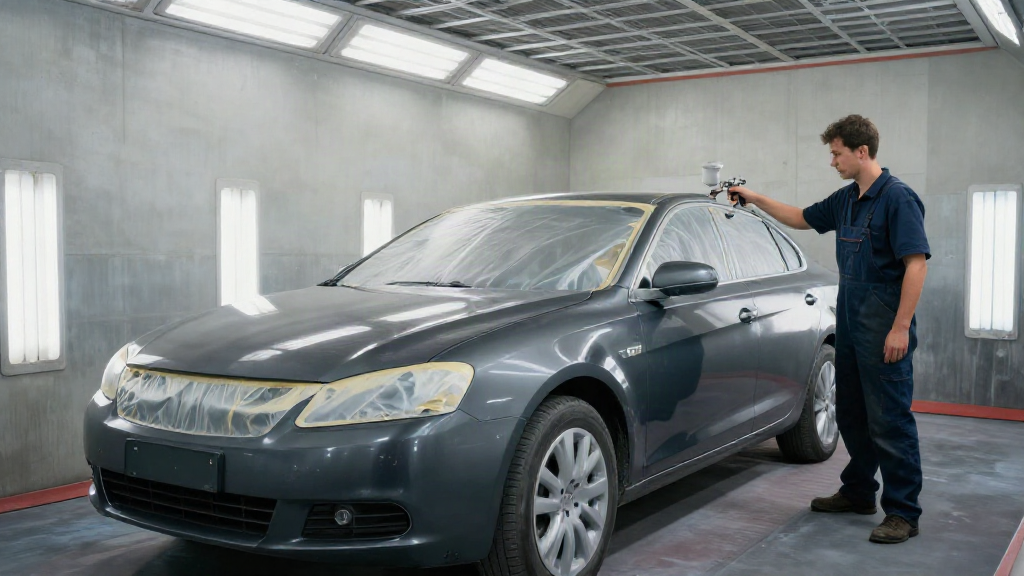
If you are pricing out paint work, the first question is almost never about price. It is about scope. A driver with a scuffed rear quarter panel and a driver with a sun-faded hood are both searching the same phrase, but they are not shopping for the same job. Understanding what a full respray covers versus a single-panel repaint is the difference between spending wisely and spending twice.
At Carbon Collision Repair, we quote a lot of paint work across Lake County and McHenry County, Illinois, and Kenosha County, Wisconsin. Most of those conversations start with one honest correction: a respray and a repaint are two very different products, and the car in front of you usually only needs one of them.
What a Full Respray Actually Covers
A full respray is a complete refinish of the vehicle’s exterior painted surfaces. In practice that means removing or masking trim, handles, mirrors, and badges; addressing dents, chips, and previous repair work; sealing and priming the whole shell; applying base coat in your factory color or a custom shade; and clearing the entire car for a uniform gloss and film build. Because every panel is sprayed in the same session, under the same conditions, with the same batch of paint, the finish reads as one continuous surface – which is the entire point of the service.
A respray also resets the clock on your paint. Faded clear coat, oxidation, heavy rock-chip clusters, and mismatched panels from earlier insurance repairs all disappear in a single pass. That is why collectors, restorers, and anyone preparing a vehicle for sale often choose this route even when the existing paint is not badly damaged.
What a Single-Panel Repaint Covers
A panel repaint refinishes one damaged area – a fender, door, quarter panel, bumper cover, or hood – and blends the new paint into the adjacent panels so the transition is invisible. It requires isolating the panel, refinishing it, and then matching color and texture to the surrounding factory finish.
This is what most collision and scratch damage actually calls for. If a shopping cart dented your door and nothing else is wrong with the car, repainting three additional panels does not make the repair better. It just makes the invoice bigger.
Car Respray Cost vs. Panel Repaint: A Side-by-Side Look
Car respray cost is driven by surface area, prep volume, and material volume. A panel repaint is driven by color-match difficulty and blend area. Neither number is fixed, and any shop that quotes you a firm figure over the phone without seeing the vehicle is guessing.
In general terms, a single-panel repaint sits in the low-to-mid hundreds for a straightforward panel with good existing paint underneath, while a full respray on a sedan or SUV typically lands several times higher because it multiplies labor hours, masking time, and paint material. Trucks, vans, heavy clear-coat damage, custom colors, and extensive bodywork push both figures upward.
Where the Money Goes in a Respray
Labor is the largest line item, and most of it is not spraying. Disassembly and reassembly, masking, sanding, and surface prep consume the majority of the hours. Materials – primer, sealer, base coat, clear coat, and consumables – follow, along with booth time for curing. A respray also carries more bodywork risk: once a vehicle is stripped, previous filler, rust, or hidden damage has to be addressed properly before paint goes on.
Why a Panel Repaint Is Priced the Way It Is
A panel repaint is smaller but more surgical. The technician still has to prep and prime, but the real cost driver is color matching – spraying test cards, tinting the mix to account for sun fade, and blending into two or three neighboring panels so no eye can spot the repair. On metallic and three-stage pearl finishes, that blending work is where the hours live.
Color Matching: The Hidden Variable in Both Options
Color match is the single biggest reason a paint job looks factory or looks repaired. On a full respray, matching is easier in one sense – every panel gets the same new mix – but harder in another, because an off-shade batch shows up everywhere at once. On a panel repaint, the challenge is matching fresh paint to paint that has spent years in the sun.
Vehicles with factory metallic, pearl, or tinted-clear finishes add cost to both paths. So does any prior repaint, because a shop has to reverse-engineer a color somebody else mixed.
Downtime and Finish Durability
Downtime tracks scope. A single-panel repaint is often a two-to-four-day job depending on parts and cure time. A full respray typically runs one to three weeks once disassembly, bodywork, paint, and reassembly are complete – and longer if rust or structural repair is uncovered.
Durability, applied correctly, is comparable. Modern base coat and clear coat systems hold up for years whether they cover one panel or ten. The difference is uniformity: a respray gives you one consistent film build across the whole car, while a panel repaint leaves older, thinner paint in place on the untouched panels.
How to Decide: Vehicle Age, Damage, and Resale Goals
Use these questions to sort out the right scope before you ever ask for a number.
-
Is the damage isolated to one or two panels, with healthy paint everywhere else? A panel repaint is almost always the smarter spend.
-
Is the clear coat failing across the roof, hood, and trunk lid at once? That is a respray pattern, not a repair pattern.
-
Is the paint faded or mismatched panel to panel from earlier work? A respray is the only path to a uniform finish.
-
Are you keeping the vehicle long term? Repainting only what is damaged protects your budget now and lets you respray later if the rest of the paint gives out.
-
Are you selling or showing the vehicle? Buyers and judges read uniformity. A full respray protects value on a collectible in a way spot repairs cannot.
-
Is this an insurance claim? Insurance pays to restore pre-loss condition, which usually means refinishing the damaged panels – not the whole car. We work directly with adjusters to make sure the approved scope matches the actual damage.
When a Partial Repair Is the Smarter Spend
For most daily drivers in Waukegan, Gurnee, Libertyville, and the surrounding communities, the honest answer is a partial repair. A car that is eight years old, structurally sound, and damaged on one fender does not need four thousand dollars of paint. It needs a correctly blended fender repaint that protects the metal and matches the rest of the car.
We tell customers this even when the larger job would pay us more. Spending on a respray you do not need takes money away from tires, brakes, and maintenance that keep the vehicle safe. That trade-off is the whole decision.
Getting an Honest Estimate in Waukegan
A real estimate requires the vehicle. We inspect the damage, check for hidden filler and rust, test the color against your existing finish, and then quote the scope that solves the problem – full respray, blended panel repaint, or paintless repair where the damage allows it. Estimates are free, we work with insurance claims, and military discounts are available.
If you are weighing car respray cost against a single-panel fix, bring the car by Carbon Collision Repair or call 224-888-4142. We will tell you plainly which one your vehicle needs, what drives the number, and what you actually get for the difference.